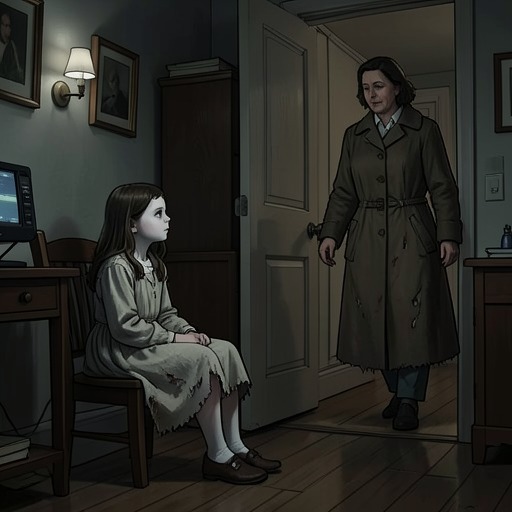
Stéphanie Runs Away
Chanson douceStéphanie Runs Away marks the break in Louise’s relationship with her daughter and reveals the loneliness beneath Louise’s exacting care of other people’s children. Stéphanie’s departure follows years of feeling like an inconvenience in the house in Bobigny; Louise reports her missing but does not look for her, and later shows little interest in the neighbors’ sparse accounts of where she has gone.
Background: A Daughter Who Feels in the Way
Louise hates weekends in part because they recall the life she shared with Stéphanie. Stéphanie complained that Sundays brought nothing to do and that Louise did not give her the activities she organized for the children in her care. The contrast is stark: Louise’s working days are structured around other people’s children, while her own daughter experiences the home as a place where she is left out.
As soon as she could, Stéphanie began escaping that home in smaller ways. On Fridays she went out all night with neighborhood teenagers and returned in the morning pale, red-eyed, and hungry. She ate standing against the refrigerator door, digging into containers Louise had prepared for Jacques’s lunches. She dyed her hair red, pierced her nose, and began disappearing for entire weekends. The absences lengthened until one day she did not come back.
The Departure and Louise’s Response
By the time Stéphanie leaves for good, neither school nor family life holds her there: she had left lycée long before, and, in the account’s blunt conclusion, nothing in the house kept her—not even Louise. Louise declares her daughter missing, but receives only the reassurance that running away is common at that age and that Stéphanie may return. No one tells her more, and Louise does not go looking.
Later, neighbors tell Louise that Stéphanie is in the South, in love, and moving from place to place. They are surprised that Louise does not ask for details or press them to repeat the little they know. The departure is thus not followed by a determined search or a reunion in the evidence presented; it remains an absence that Louise allows to stand.
A Life of Invisibility
The narration places Stéphanie’s escape within her sense that she had always been a nuisance. Jacques was disturbed by her presence; her laughter woke the children Louise minded. In the narrow hallway, she pressed her heavy thighs and broad profile against the wall to let others pass, afraid of blocking the way, being jostled, or taking a chair someone else might want. Even her laughter could offend, though it was innocent, and she felt that she spoke badly.
The image of Stéphanie making herself small in the corridor culminates in her disappearance. She has developed, the narration says, a talent for becoming invisible; her final departure seems to follow that habit without noise or warning, as though it were where her life had been leading. The account does not present the escape as a sudden, fully explained rebellion. It connects it instead to an accumulated experience of not having room—to speak, laugh, sit, or belong.
The Unequal Distribution of Care
Louise’s attentiveness elsewhere sharpens the loss. In the Massé household she records school and dance schedules, pediatric appointments, medicines, and even the exact words Mila’s teacher has said in a small flower-covered notebook. When Myriam tells her she can stop cleaning the bathtub and go home, Louise continues scrubbing, folds towels, empties the washing machine, and prepares the children’s beds. She becomes both invisible and indispensable in the household she serves.
That practical devotion does not erase the distance between Louise and Stéphanie. At the Massé apartment, Louise can take over routines and make the household run smoothly; her own daughter’s complaints about Sundays and the unequal attention given to other children remain unresolved. The contrast gives Stéphanie’s departure its force: the person who meticulously keeps other families’ lives in order has not made her daughter feel there is a place for her at home.
Aftermath and Significance
Stéphanie’s absence belongs to Louise’s broader pattern of withdrawal and isolation, but the account does not suggest that Louise’s later actions cause the escape. It shows instead how she responds to the news: she registers the disappearance, receives a vague assurance, and does not pursue the neighbors’ information. The gap between the daughter’s growing absences and the mother’s failure to seek her out makes the separation emotionally consequential without supplying an explanation that the text withholds.
The episode also reframes Louise’s competence as a caregiver. Her carefully maintained household routines and self-effacing service to the Massés coexist with a history in which her own daughter felt there was no room for her. Stéphanie’s flight is therefore not only a family rupture; it is a sharp instance of the book’s recurring tension between visible domestic labor and the intimate bonds that such labor cannot guarantee.